


Publications
The list of interesting books, papers, and chapters published both by the N.EA team members and other researchers.
- Details
- Category: Publications
- Hits: 1
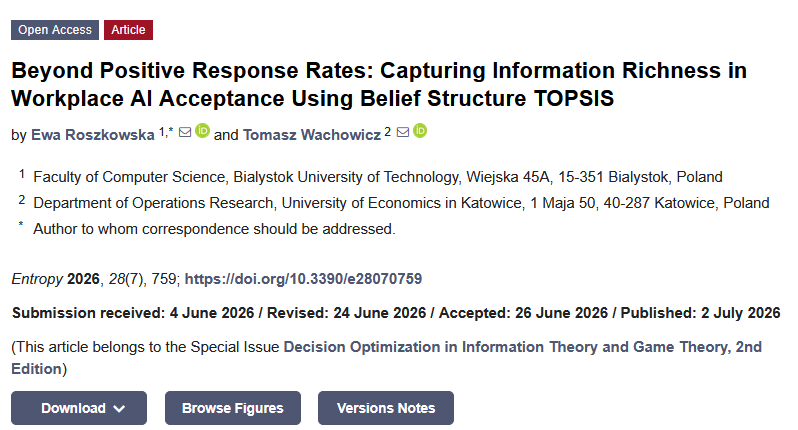 On July 2, 2026, a scientific article titled "Beyond Positive Response Rates: Capturing Information Richness in Workplace AI Acceptance Using Belief Structure TOPSIS" by Prof. Ewa Roszkowska and Tomasz Wachowicz was published in the journal Entropy. The paper presents the implementation of a previously developed tool—Belief Structure TOPSIS—to analyze survey data regarding the acceptance of AI tools in the labor market across European Union countries. Additionally, it proposes extending the stability analysis of the obtained results through automated simulation analysis and the verification of almost stochastic dominance.
The article is available directly at the following link: https://www.mdpi.com/1099-4300/28/7/759
- Details
- Category: Publications
- Hits: 1
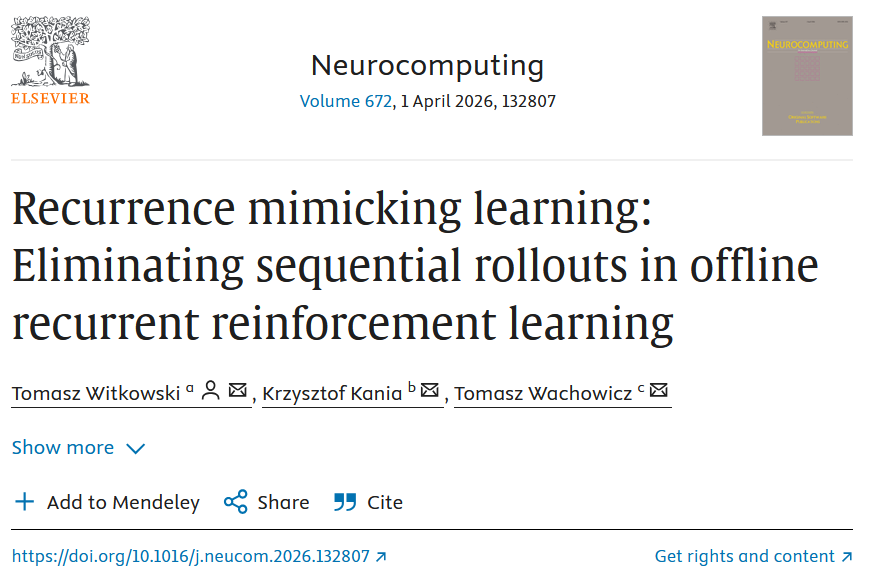
On April 1, 2026, the scientific article titled "Recurrence mimicking learning: Eliminating sequential rollouts in offline recurrent reinforcement learning" was published in the journal Neurocomputing (and this is no April Fools' joke), presenting an interesting proposal for enhancing the training processes of recurrent neural networks. Authored by Tomasz Witkowski, M.Sc., Prof. Krzysztof Kania, and Prof. Tomasz Wachowicz, the paper demonstrates how to significantly accelerate the development of decision-making tools used in dynamic decision-making problems.
The article is available directly at the following link: https://www.sciencedirect.com/science/article/pii/S0925231226002043
- Details
- Category: Publications
- Hits: 830
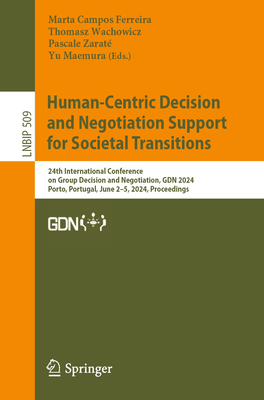 From June 2-5, the 24th conference on Group Decision and Negotiation (GDN) took place in Porto, jointly with the ICDSST conference organized by EWG-DSS. Papers submitted to the GDN conference are typically published in two types of post-conference proceedings: local proceedings, published by the organizer (in 2024, the University of Porto), and Springer proceedings, published as part of the Lecture Notes in Business Information Processing (LNBIP) series. The co-editor of this year's GDN LNBIP volume (No. 509) was Professor Tomasz Wachowicz, and the entire editorial team included Marta Campos Fereira (University of Porto), Pascale Zarate (University of Toulouse), and Yu Maemura (University of Tokyo). Conference participants received free four-month electronic access to the volume. It is also available for purchase on the publisher's website: https://link.springer.com/book/10.1007/978-3-031-59373-4
- Details
- Category: Publications
- Hits: 413
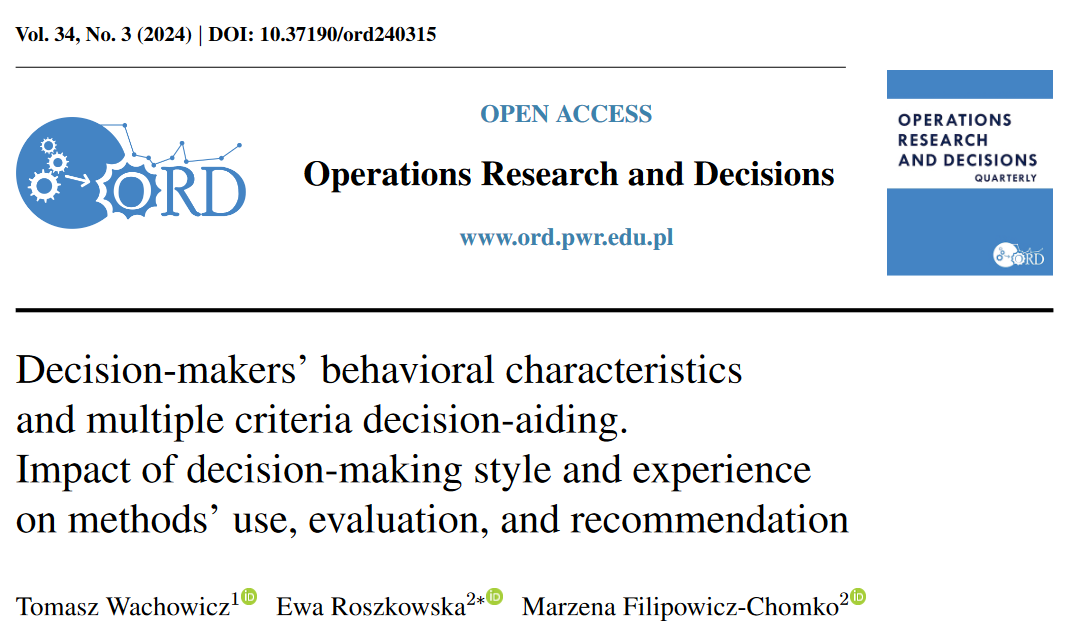 Another interesting article by the N.EA team has been published in the journal Operations Research and Decisions. In this article, we conduct a very detailed analysis of the impact of various behavioral characteristics of decision-makers on their use of different multiple criteria decision-aiding (MCDA) methods and their final opinion regarding recommendations and future use of these methods. The conducted empirical study utilized a proprietary online decision support and survey system, and the data from the system was analyzed using a complex structural model that accounts for both direct and indirect influences of exogenous variables on the final assessment of MCDA methods’ functionality.
The article is available directly via the following link: https://ord.pwr.edu.pl/Issues/2024/vol34/p3_15
- Details
- Category: Publications
- Hits: 742

Today, an interesting article by Prof. Ewa Roszkowska and Tomasz Wachowicz was published in the journal Entropy. It discusses the use of entropy concepts for generating weights in a multi-criteria decision-making problem and their impact on the ranking outcomes of decision variants. The work utilized the Hellwig method for positioning EU countries based on the degree of sustainable development in education. It highlights ambiguities stemming from the often-used double normalization in the analytical process (one for determining entropy weights, the other related to the Hellwig method itself) and shows that observing individual decision cases can lead to illusory beliefs about the similarity of results obtained for different analytical combinations. Although in the problem of sustainable development of education, choosing different analytical methods led to different weights but similar rankings of variants, it turned out that this is due to special correlational relationships between evaluation criteria. In cases where these correlations are eliminated, the differences in both weights and rankings can be very significant.
The article is available directly at the link: https://www.mdpi.com/1099-4300/26/5/365
- You are here:
-
Home

- Publications